
 What Termites Reveal About the Social Contract of Culture
A worker termite spends its entire life building a structure it will never own. It defends offspring it did not produce and, in most species, will never produce any of its own. It cannot leave and it cannot survive on its own. It was never asked whether any of this was acceptable.
The point is not to feel sorry for an insect. It is that every organisation faces some version of the same question, even if it never puts the question into words: what does the collective ask its members to give up, and what does it give back in return?
The classical problem
Seventeenth- and eighteenth-century political philosophers wrestled with exactly this problem. Hobbes1 argued that life outside organised society, his “state of nature”, is solitary and precarious, with no guarantee that cooperation will be honoured. His social contract spells out the exchange: unconstrained individual freedom is given up, and security and protection are received in return. Rousseau2, writing a century later, went further: submitting to the collective will is not pure loss. Done well, identifying with the group produces a kind of freedom the isolated individual never had.
Neither philosopher had termites in mind. But the termite mound gives their argument something philosophy alone cannot: an actual case to look at, rather than a thought experiment.
Why it holds together
An isolated worker termite does not just lose comfort, it loses the ability to function. Removed from the colony, it becomes disoriented and often fails to survive; put back, its behaviour returns to normal. For a termite, the “state of nature” is not a thought experiment. It is the literal absence of the social contract, and it is barely survivable. Something similar may apply to people who leave long-term employment, whether through retrenchment, retirement, or a move into entrepreneurship, what is lost is not only the salary.
In the human case, money does much of the work of holding the employment relationship together. A termite has no equivalent. What holds a worker termite to the bargain is not consent in any sense we would recognise, but kinship. Hamilton’s3 theory of inclusive fitness explains this kind of self-sacrifice in genetic terms: an individual can serve its own genetic interest indirectly, through the reproductive success of close relatives, not only through having offspring of its own. Because a termite colony typically descends from a single founding pair, a worker giving up its own reproduction is, in effect, investing in full siblings rather than strangers. The contract holds because there is no genetic upside to defecting, a different enforcement mechanism from Hobbes’s sovereign, but doing the same job.
How the colony builds a culture
Two further mechanisms turn this bargain into something recognisable as culture, rather than mere biological obligation.
The first is caste determination. In many termite species, an individual’s eventual role in the colony is not fixed at birth. It is written onto it afterwards, through chemical and social signals from the rest of the colony4. This is close to what organisational theory calls inculturation: identity and function are not given in advance but conferred through exposure to an existing social order, after the individual is already part of it.
The second is stigmergy: a form of indirect coordination in which individuals act on the traces left by others’ prior activity, rather than communicating directly. The French entomologist Pierre-Paul Grassé5 coined the term after watching termites build their nests.
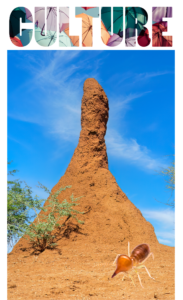
No termite, and no central authority in the colony, designs the mound. It emerges from individuals responding to what others have already done: a deposited grain of soil attracts further deposits, and an entire, ventilated structure results from purely local responses, with no plan held anywhere.
This is culture in the sense Schein6 describes as the artefact layer of organisational culture: a structure that outlasts any single contributor, that no one designed in full, and that still shapes, and is shaped by, the behaviour of everyone who encounters it afterwards.
Where the analogy stops
The termite case should not be made to carry more weight than it can bear. Termite culture is non-symbolic: there is no shared system of meaning that members interpret, argue about, or revise, in the way Geertz7 described human culture. Pheromone signalling regulates behaviour, but it does not amount to an order that can be questioned. That is what makes the analogy useful: it shows what culture looks like as pure structural regulation, stripped of interpretation and the possibility of disagreement, so that what is different about the human case stands out more clearly.
What is different is what Rousseau’s argument already pointed to, reflexivity. A person can ask what the organisation is offering in return for what it asks of them. They can contest the terms, renegotiate them, or leave, none of which is available to a worker termite. Freedom within limits is not, in the human case, a polite word for restriction. It is a freedom that exists only because the terms of belonging can, at least in principle, be examined.
The practical question
Every organisation runs some version of this arrangement, whether it names it or not: a degree of individual autonomy given up, in exchange for protection, belonging, and a role that did not exist for that person before they joined. A termite cannot ask what it has agreed to. A person can, but only if the terms of the culture they have joined are visible enough to be examined in the first place. Making those terms visible is the real work of a culture assessment.
The termite case describes what a culture asks of its members, and what it gives back. It says less about who is responsible for setting those terms, or how much room there is to change them. For that, it helps to step back further, to a South African thinker who spent much of his career asking what a “whole” actually is, and how much freedom exists at each level of one.
Holism
Jan Smuts signed the founding charters of both the League of Nations and the United Nations, the only person to do so, and he wrote the first draft of the preamble to the UN Charter itself8. He had been developing the idea of holism since at least 1910, growing out of questions he had first explored as a student at Cambridge. The finished version appeared in 1926 as Holism and Evolution9.
Its central claim is easy to state but harder to apply. A whole, a cell, an organism, a mind, a society, has properties that cannot be found in, or predicted from, its parts taken separately. The whole is not simply the sum of its parts. It is something new, sitting one level up from what produced it.
A whole, in Smuts’s account, is never sealed off. It is a centre of activity that radiates outward into everything around it, and is continuously shaped by it in turn, including its own history and its unrealised potential. The edge of a whole is functional rather than literal: it marks where its influence becomes harder to detect, not where the whole stops existing. This is, in effect, an open-systems account of organisation, worked out decades before the social sciences gave the idea a name.
From cells to societies
Smuts arranged wholes in a rough hierarchy, matter, cell, organism, mind, personality, society, with each level emerging from the one below it while remaining permeable to it. A similar idea appears three decades later in Boulding’s10 levels of systems. The hierarchy is not only one of complexity. It is also one of increasing freedom. A cell is almost entirely determined by its biochemical environment. A personality has enough internal coherence and room for creativity to act back on the environment that produced it, rather than simply being shaped by it. That distinction matters: it is the difference between someone who is only a product of their culture and someone who also, eventually, takes part in remaking it.
What leaders are actually custodians of
This gives a sharper way of thinking about leadership and culture than the usual language of ownership. A leader does not own a culture the way they might own an asset: sealed, fixed, fully controllable. What they are actually responsible for is its boundary condition, what is allowed to cross in (new hires, outside ideas, market pressure, client expectations) and what is allowed to cross out (behaviour, reputation, the visible expression of stated values).
Smuts’s hierarchy puts this responsibility at its highest level, because personality, his term for the most developed stage of a whole, is the first stage with enough freedom to act deliberately on the field around it, rather than simply being shaped by it. A leader who understands this is not managing a sealed culture. They are managing its permeability: deciding, often without realising it, how open or closed its edges are, and to what. What actually crosses that edge, what a culture lets in, what it keeps out, and what it leaks regardless of intent, is rarely visible without deliberate measurement. Termites cannot inspect the terms of the contract they were born into. People can, but only if someone is deliberately managing what crosses the boundary of the culture they have joined.
Endnotes
- Thomas Hobbes, Leviathan, ed. Richard Tuck (Cambridge: Cambridge University Press, 1996; first published 1651).
- Jean-Jacques Rousseau, The Social Contract, trans. Maurice Cranston (London: Penguin Classics, 1968; first published 1762).
- W. D. Hamilton, “The Genetical Evolution of Social Behaviour I and II,” Journal of Theoretical Biology 7, no. 1 (1964): 1-52.
- Barbara L. Thorne, “Evolution of Eusociality in Termites,” Annual Review of Ecology and Systematics 28 (1997): 27-54.
- Pierre-Paul Grassé, “La reconstruction du nid et les coordinations interindividuelles chez Bellicositermes natalensis et Cubitermes sp. La théorie de la stigmergie,” Insectes Sociaux 6, no. 1 (1959): 41-80.
- Edgar H. Schein, Organizational Culture and Leadership, 4th ed. (San Francisco: Jossey-Bass, 2010).
- Clifford Geertz, The Interpretation of Cultures (New York: Basic Books, 1973).
- W. K. Hancock, Smuts: The Fields of Force, 1919-1950 (Cambridge: Cambridge University Press, 1968).
- Jan C. Smuts, Holism and Evolution (London: Macmillan, 1926).
- Kenneth E. Boulding, “General Systems Theory-The Skeleton of Science,” Management Science 2, no. 3 (1956): 197-208.

Leave a Reply