
Total Quality Management, Business Process Re-engineering, and Learning Organisation.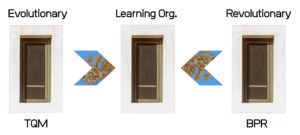
Most organisations facing problems reach for an intervention. Fewer ask which kind of intervention the situation demands. Even fewer have a conceptual framework that would allow them to answer that question. The three systems traced below did not emerge from abstract theorising. Each system was a response to a specific organisational condition. Understanding what problem each was built to solve is the first step toward matching intervention to circumstance.
Organisation Development is often seen as individual, team based, or specific process interventions. While individual interventions have their value, organisations might need a more comprehensive intervention. Organisations have the same reality as a person whose health needs may vary from taking a tablet to needing an intensive operation.
Change is often described on a continuum, from evolutionary – slow and incremental –to revolutionary – large-scale – change. Evolutionary change is often seen as easier and less disruptive while revolutionary change is more disruptive and more challenging. When considering organisation development, the key question is not what is scary, but what is needed. Where does the organisation lie on the scale of industry performance? What are the realities of organisational functioning and what is needed to ensure strategic competitiveness?
Organisation Development has three discernible yet interconnected macro change systems, each with multiple sub-processes. These are Total Quality Management (TQM), Business Process Re-engineering (BPR), and Learning Organisations (LO). Although the focus here is on change systems, they cannot be considered without understanding that organisation culture is core to the success or failure for them all.
Total Quality Management
Total Quality Management (TQM) is one of the most pervasive, and perhaps misunderstood, management systems. TQM started shortly after the Second World War with the purpose of rebuilding Japanese manufacturing to world standards. Quality management is deeply rooted in Japanese culture and is linked to current lean methodologies. The lean focus is driven by the drive for eliminating “Muda” which is the collective term for waste. Coming from a country with limited natural resources and being devastated during the war, the elimination of waste is a core rallying call.
Drawing on early business science, TQM involved a comprehensive, organisation-wide approach to continuous improvement. Its principles run through the Shewhart cycle, adapted by Deming. Deming also emphasised statistical process control, the reduction of variation, and the systemic accountability of management for quality outcomes.[i] This was further supported by work in the fields of quality control and standardisation by Juran.[ii] Both these approaches frame quality as a strategic and systemic concern rather than a purely technical or inspection-based function.
Interesting is that Six Sigma is fundamentally built on statistical process control which was key in TQM. More recent agile teams or self-directed work teams were heavily influenced by quality circles and quality management teams. Six Sigma and agile’s self-organising teams extend the same premise — that the people doing the work are best placed to improve it — into knowledge work. An organisation adopting Six Sigma or agile without also adopting TQM’s underlying trust in employee judgement, gets the technique without the culture that made it work.
TQM rests on several interlocking principles. Customer satisfaction is the ultimate arbiter of quality. All employees, across all functions, are involved in quality improvement. A process orientation seeks to understand and optimise the workflows through which outputs are produced. Data-driven tools are used to identify and eliminate sources of defect and waste.
Unfortunately, many western organisations focussed primarily on productivity aspects and TQM failed to take hold. TQM is as much a cultural aspect as a set of processes.
Successful TQM requires a genuine communal compact between employer and employee. This includes an explicit management commitment that no one would lose their position because of identifying inefficiency or proposing a better method. Second is a firm belief in human potential that a person performing tasks below their ability. This belief is itself a form of muda interpreted as that if a machine can perform a task, the appropriate response is to train the person to manage the machine, not to eliminate the role. Third is a willingness on the part of management to relinquish direct control of improvement processes. This does not mean drop of standards but a willingness to listen to those doing the work. Working from the understanding that they are best placed to identify how it might be done better.
In essence, TQM is a system with multiple techniques and processes aimed at incremental improvements. The system is however underpinned by a communal focus and a culture striving for involvement and recognition of all employees.
Business Process Re-engineering
Business Process Re-engineering (BPR) is a radical departure from the incremental improvement logic that had characterised earlier quality management movements. Where TQM seeks gradual, continuous improvement of existing processes, BPR calls for their fundamental redesign. The concept was given shape by Hammer and Champy as “the fundamental rethinking and radical redesign of business processes to achieve dramatic improvements in critical contemporary measures of performance, such as cost, quality, service, and speed”.[iii] This formulation is explicitly antagonistic toward incremental thinking. It insisted that organisations abandon inherited assumptions and ask whether existing processes should be improved or discarded altogether. The concept of feature creep is found in IT meaning improvements that eventually makes a program hard to use and “unfriendly”. In summary, BPR works from the mindset of “knowing what I know, if I were to do/design this for the first time, how would I do it”.
BPR was heavily enabled by the rapid diffusion of information technology in the 1980s and early 1990s. That made it technologically feasible to redesign cross-functional processes in ways previously impractical. This is taken even further with the growth in AI, sometimes without full understanding or workplace realities.
Davenport[iv] offered a parallel but somewhat more measured account, emphasising process innovation as a synthesis of organisational and technological redesign rather than the seemingly uncompromising demolition advocated by Hammer and Champy. Davenport’s framing acknowledged the importance of human factors and change management considerations that the more radical strand of BPR rhetoric tended to elide.
The implementation record of BPR proved contentious. Surveys conducted during the mid-1990s reported high rates of failure or partial achievement, with estimates suggesting that between 50 and 70 per cent of re-engineering initiatives fell short of their objectives.[v]
The current mention of organisations that reduce staff to use AI seem to now be turning back to staffing. Critics attributed these failures to the movement’s tendency to discount the human dimensions of organisational change. The implementation of BPR also became a legitimating cover for large-scale workforce reductions. Willmott[vi] offered a more politically grounded critique, arguing that BPR’s rhetoric of radical transformation served managerial power interests while concealing the coercive aspects of its implementation.
Notwithstanding these critiques, BPR contributed enduring concepts to the management theory. In particular the notion of the process as the primary unit of organisational analysis and the imperative of cross-functional integration has become key. Elements of BPR thinking persist in Enterprise Resource Planning (ERP) implementations, shared services models, and digital transformation programmes. This suggests that, while its most radical prescriptions have been tempered by experience, as concept it continues to shape how organisations approach structural redesign.
Given the above, it again becomes clear that culture is core in any change process. BPR also has a cost implication in the possible reduction in profits against a backdrop of business changes during the early 1980s and 1990s. These changes are also linked to the key problems of disruption of loyalty between employer and employee. The principle of at times starting afresh is however key.
The Learning Organisation
The most recent development is the learning organisation which emerged as a response to the accelerating pace of environmental change of the latter part of the twentieth century. Changes at that time are linked to the ending of long-term employment. This change in employment pattern, and the cost of employee development is a key driver of this process. The underlying driver is this is the opposite of what TQM’s communal compact depended on.
The learning organisation is referred to as a firm that cultivates the capacity of its members to continuously expand knowledge, adapt mental models, and generate new capabilities aligned with organisational purpose. The foundational articulation of this concept is generally attributed to Senge[vii], whose landmark work The Fifth Discipline synthesised systems thinking with organisational behaviour. The key argument is that genuine competitive advantage lies not in static resources but in an organisation’s capacity to learn faster than its rivals. This against a backdrop of increased short-term staff turnover.
Senge identified five disciplines that, taken together, constitute the infrastructure of a learning organisation. Subsequent theorists extended and critiqued Senge’s framework. Nonaka and Takeuchi noted that organisational learning is driven by the dynamic conversion between tacit and explicit knowledge through processes of socialisation, externalisation, combination, and internalisation[viii]. Garvin offered a more operationally grounded definition, framing the learning organisation as one “skilled at creating, acquiring, and transferring knowledge, and at modifying its behaviour to reflect new knowledge and insights” [ix].
It is clear that the development of a learning organisation involves the creation of a culture and trust where learning is fostered.
Where TQM’s critics could point to a concrete failure rate and BPR’s critics to Willmott’s account of managerial power, the learning organisation’s difficulty is more diffuse. Organisations tend not to fail at it so much as quietly not attempt the harder parts of it, retaining the vocabulary of shared vision and systems thinking while the underlying practice of double-loop questioning goes untried.
What connects all three frameworks examined here — TQM, BPR, and the learning organisation — is that each depends, as a structural precondition, on a culture capable of sustaining it.
[i] The Shewhart cycle was first articulated in Walter A. Shewhart, Economic Control of Quality of Manufactured Product (New York: D. Van Nostrand, 1931). Deming’s adaptation and the Plan-Do-Check-Act model appear in W. Edwards Deming, Out of the Crisis (Cambridge, MA: MIT Press, 1986).
[ii] Joseph M. Juran, Juran on Planning for Quality (New York: Free Press, 1988).
[iii] Michael Hammer and James Champy, Reengineering the Corporation: A Manifesto for Business Revolution (New York: HarperBusiness, 1993), 32.
[iv] Thomas H. Davenport, Process Innovation: Reengineering Work through Information Technology (Boston: Harvard Business School Press, 1993).
[v] Michael Hammer and Steven A. Stanton, The Reengineering Revolution: A Handbook (New York: HarperBusiness, 1995).
[vi] Hugh Willmott, “Business Process Re-engineering and Human Resource Management,” Personnel Review 23, no. 3 (1994): 34–46.
[vii] Peter M. Senge, The Fifth Discipline: The Art and Practice of the Learning Organization (New York: Doubleday, 1990).
[viii] Ikujiro Nonaka and Hirotaka Takeuchi, The Knowledge-Creating Company: How Japanese Companies Create the Dynamics of Innovation (New York: Oxford University Press, 1995).
[ix] David A. Garvin, “Building a Learning Organization,” Harvard Business Review 71, no. 4 (1993): 78–91; quotation at 80.
[CE1]The ‘not X, but Y’ construction appears three times across the piece (here, in the Senge paragraph, and in the TQM accountability sentence). Your style guide flags this as an AI-writing tell past one or two uses – worth varying the phrasing in at least one spot.

Leave a Reply