

A series for contemplation, sharing, and discussion over coffee.
The series published on vanrooyen.info is not a set of disconnected blog posts. It is a coherent intellectual project aimed at a senior management audience: the argument that effective leadership in the current environment requires genuinely internalised conceptual frameworks — not tools to be selected from a menu, but lenses through which one sees. The four concepts (systems thinking, strategic thinking, cultural understanding, change management) are introduced as a system, not a list.
Most of what passes for insight in organisational life is either too abstract to be useful or too tactical to last. These reflections are an attempt to occupy the space in between: writing that is grounded in theory but firmly anchored in the realities of practice, and aimed at anyone who leads, manages, or advises organisations and wants to think more clearly about what they are doing and why.
The reflections address substantive organisational and societal questions in a more conceptual approach, reading between the lines, examining the mental models and assumptions that shape — and often constrain — how we think about strategy, culture, and organisational change. It traces the roots of business functioning from early human survival behaviour through to contemporary management practice.
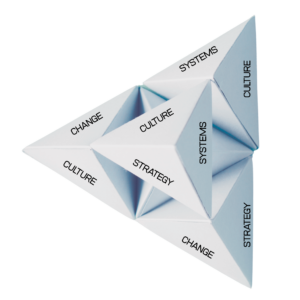
The only diagrammatical way to represent these four is as a tetrahedron or a three-dimensional figure with four triangular faces – the international shorthand for change. In normal terms it can be described as a three-sided pyramid. The three sides of the pyramid represent change, strategy, and culture. Underpinning all of it is a systems-thinking perspective: the conviction that strategy, culture, and change cannot be understood in isolation from one another, and that the most persistent management failures tend to result from treating complex human systems as though they were simple mechanical ones.
A new postwill be published every week. Some will challenge assumptions. Some will offer frameworks. All of them are written with a single purpose: to translate decades of insight into ideas. Ideas that are accessible, principled, and genuinely useful to the people who lead and develop organisations.
Pull up a chair. The coffee’s on.
Register to receive email notification when they are published

- Reflection 19: Culture and Seeing small
 Understanding Culture: The art of seeing small There are four somewhat unrelated, yet similar, perspectives on considering small things. The first is a biblical verse that states, “Catch the foxes for us, The little foxes that are ruining the vineyards, While our vineyards are in blossom.”[i] In every-day life this is generally used to indicate … Continued
 - Reflection 18 – Culture as System
 Systems thinking is a discipline for seeing wholes. It is a framework for seeing interrelationships rather than things, for seeing ‘patterns of change’ rather than static ‘snapshots.’ Peter Senge[i] It is often said that real understanding of a topic only comes once you see how its parts work together. The reality is that trying to … Continued
 - Reflection 17 – The Past Runs Your Organisation
 Understanding where your workplace culture really comes from Organisational culture is one of those terms everyone uses, and no one defines quite the same way. At its simplest it is just “the way we do things around here.” That short phrase, often attributed to Deal and Kennedy[i], turns out to carry something important. At its … Continued
 - Reflection 16 – Triad of Change Management Systems
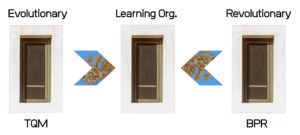 Total Quality Management, Business Process Re-engineering, and Learning Organisation. Most organisations facing problems reach for an intervention. Fewer ask which kind of intervention the situation demands. Even fewer have a conceptual framework that would allow them to answer that question. The three systems traced below did not emerge from abstract theorising. Each system was a response to … Continued
 - Reflection 15 – The Deal You Never Signed
 What Termites Reveal About the Social Contract of Culture A worker termite spends its entire life building a structure it will never own. It defends offspring it did not produce and, in most species, will never produce any of its own. It cannot leave and it cannot survive on its own. It was never asked … Continued
 - Reflection 14 – Levels of OD (Functional vs Strategic)
 Departmental or Strategic Organisation Development. Introduction Organisation Development (OD) has, since its formalisation in the mid-twentieth century, carried a persistent ambiguity of scope. In its most familiar guise, OD is a practice — a set of planned, human-focused interventions (team-building, survey feedback, process consultation, conflict resolution) applied at the level of groups and individuals to … Continued
 - Reflection 13 – Why Organisations Look the Same.
 Why Do Organisations Always End Up Looking the Same? Deep down, are they different? 1. The Central Puzzle: Despite the enormous differences between organisations in what they do, where they operate, and when they came into existence, they tend to fall into a surprisingly small number of recognisable shapes. This is not a trivial observation. Organisations … Continued
 - Reflection 12: Strategic Planning Cycle
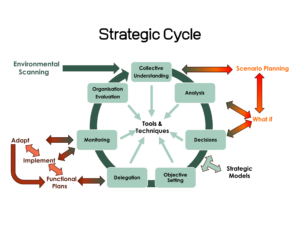 Strategic planning is too often reduced to an exercise: apply a framework, fill in a template, produce a document. There are many books and articles on strategy, strategic management, tools, and techniques to use and many more books on strategic models and strategic mindsets are published annually. Unfortunately, this wealth of information and the sheer … Continued
 - Reflection 11 – Socrates, Critical Thinking, and AI
 Socrates, Critical Thinking, and AI Living with questions in a time of fake news New Developments This topic touches every organisation, every leader, and every individual navigating the modern world. It provides a conceptual foundation that underpins effective functioning across all areas of strategy, culture, and change. The world is in what has, for many … Continued
 - Reflection 10 – Borrowed Risk
 How the CEO Became an “Entrepreneur” and Why It Matters to the Rest of the Organisation Introduction Walk into any airport bookshop, and you will find a shelf of business memoirs whose titles, taken together, describe a particular self-image: the visionary, the disruptor, the founder, the risk-taker, or the leader. These books are written by, … Continued
 - Reflection 9 – Laws of Nature, People, & Change
 Laws of Nature, Their Relevance to People, Organisations, Systems, and Organisation Development. In this reflection, we focus on a few laws of nature from the exact sciences. Some of these will surface again in later reflections. The application of natural laws to human and organisational systems is not a new idea. General systems theory – … Continued
 - Reflection 8 – The Strategic Tower
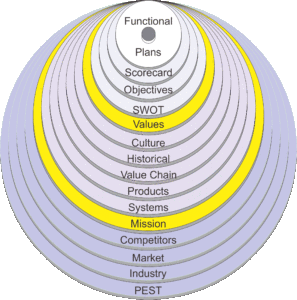 Levels of Considerations in Strategic Planning Introduction There is a model developed by mathematician Eduard Lucas with many names but often called the Tower of Hanoi. The model comprises three pegs and several discs of varying sizes, stacked in order of size, with the smallest on top. The objective is to move the discs to … Continued
 - Reflection 7 – Strategy and Planning
 Millions or Billions, wasted or well spent? Millions – if not billions – of rands and dollars are spent annually on strategic planning sessions. Whether all of this represents genuine value or significant waste is a question worth asking. Consultants would probably agree that a large proportion of strategic plans end up stored somewhere, forgotten … Continued
 - Reflection 6 – Has Capitalism Failed Us?
 Are we in a perfect storm? Open any news article, and it becomes clear that executive remuneration has become a contentious issue. To discuss this, we first need to step back and look at the broader environment in which organisations operate. A useful tool for this is the PEST analysis – a framework commonly used … Continued
 - Reflection 5 – Change and Change Agents
 Change, Strategy, Culture, and the Change Agent It has become a cliché to speak of the pace and degree of change in the 21st century – yet the observation is ancient. The philosopher Heraclitus (c. 540–480 BC) held that “on those who enter the same rivers, ever different waters flow,”1 and Plato expanded on this, writing … Continued
 - Reflection 4 – The Eternal Business Story
 From Hunting and Gathering to Strategic Management The basis of business – whether it is called that or not – has existed for thousands of years. Fundamentally, businesses still function along principles that would have been recognisable to our earliest ancestors: hunting and gathering. The key difference is that the actual hunting and gathering have … Continued
 - Reflection 3 – Categories and Groupings
 Science, Systems, and Change “If our small minds, for some convenience, divide this glass of wine, this universe, into parts – physics, biology, geology, astronomy, psychology, and so on – remember that nature does not know it.” – Feynman, R. P. (1964)¹ Introduction: The Dangers of Neat Categories It is not unusual to hear people … Continued
 - Reflection 2: Models for Understanding:
 From Parts to Purposeful Wholes. There is a deceptively simple model used in the development of training materials that carries a profound insight about the nature of learning. It is called the Whole-Parts-Whole (WPW) model. As the name suggests, it begins by presenting the whole – the complete picture – before moving into the constituent … Continued
 - Reflection 1: The Choice.
 Changing course and why managing with yesterday’s thinking produces tomorrow’s failures. If up to 75% of organisational change initiatives fail — a figure that has been regularly used since the late 1900s — what makes you confident that the next one will be different?
All Reflections written by Jan van Rooyen
