
Change, Strategy, Culture, and the Change Agent
 It has become a cliché to speak of the pace and degree of change in the 21st century – yet the observation is ancient. The philosopher Heraclitus (c. 540–480 BC) held that “on those who enter the same rivers, ever different waters flow,”1 and Plato expanded on this, writing that Heraclitus believed “you could not step into the same river twice.”2 Over time the sentiment has been rephrased many ways; what endures is the recognition that change is not a contemporary phenomenon but a permanent condition.
Change ranges from the trivial – a new toothbrush, rearranged furniture – to the catastrophic: the loss of everything one holds dear, or, as history records, conquest, exile, and slavery. What these examples share is the feature that something is different from what it was. What differs between them is the degree. For many people, a sense of control over an unrelated domain, a future goal, or even a dream is what makes the difference between adaptation and collapse. Viktor Frankl’s work on meaning as a survival mechanism remains one of the most compelling accounts of this.3
Strategy, Culture, and Change: A Systemic View
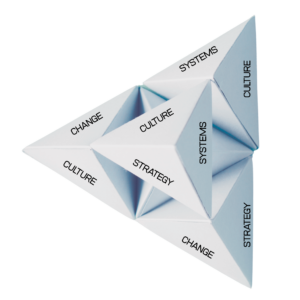
The world in which organisations operate is in constant flux, and strategy must move with it. Strategy influences culture; culture shapes how strategy is experienced and implemented; and change, whether planned or imposed, disturbs both. Describing strategy and culture as “two sides of a coin” captures something real, but it understates the complexity. Once organisational change is added to the equation, the more useful image is a three-sided pyramid – and that pyramid can only be understood when it rests on a base of systems thinking. These four concepts – systems thinking, strategy, culture, and change – form a tetrahedron: four interconnected faces, each dependent on the integrity of the others.
What systems thinking contributes is the recognition that strategy, culture, and change are not sequential steps but a dynamic, mutually reinforcing system. In a conventional linear model, strategy is formulated, culture diagnosed, and change implemented as if each were independent. Systems thinking, by contrast, draws attention to feedback loops, unintended consequences, and the interdependence of variables routinely treated as separate. Senge’s concept of the learning organisation4 provides a useful frame: organisations that learn are those in which these relationships are understood dynamically rather than mechanically. Ackoff5 reinforces the point by arguing that the properties of a system are not possessed by any of its parts in isolation – the capacity for effective change belongs to the whole, not to any single intervention. This is what distinguishes systemic change from piecemeal problem-solving.
At the centre of this tetrahedron – managing the interactions between its faces – is the person or team referred to as the change agent or change champion.
The Change Agent: Definition and Role
The change agent has occupied a central place in organisational theory since at least the mid-twentieth century, when scholars began to distinguish between those who manage the status quo and those tasked with disturbing it. At its most fundamental, a change agent is an individual – or, less commonly, a group – who deliberately sets out to facilitate, guide, or implement organisational transformation,6 working at the intersection of strategic intent, interpersonal influence, and positional power.
Change agents may be external – consultants or facilitators entering a client system to create conditions in which the organisation can change itself, without imposing change from outside – or they may be internal, a role rather than a title, embedded in the organisational fabric. The distinction carries real practical consequences. External agents bring independence, fresh perspective, and specialist expertise, but may lack contextual knowledge and will not be present for the long-term embedding of change. Internal agents bring contextual knowledge and established relationships but may be constrained by institutional loyalties and political history.7 Kotter8 notes that the internal change agent must manage relationships and organisational politics while simultaneously anchoring the change in culture; Zaltman and Duncan9 add that any effective agent must be capable of assessing organisational readiness and modelling the desired future state.
Tichy’s Typology: What Change Agents Do and How
Tichy10 developed one of the earliest and most systematic typologies of change agents, identifying three broad orientations they draw on: technical (formal structures and work design), political (relationships, coalitions, and the deployment of power – reflected most visibly in restructuring and in Chandler’s11 principle that “structure follows strategy”), and cultural (shared meanings, values, and symbols, drawing on anthropology and sociology). From these orientations, Tichy identified four distinct agent types, differentiated across five domains: personal characteristics; values relative to social change; conceptualisations of what mediates change; the technologies employed; and the settings in which change work is carried out.
The differences between these types are not merely operational: they concern what each considers to constitute success. It also follows that the appointment of change agents is itself a consequential act, shaped by the beliefs and assumptions of whoever appoints them. The risk – too seldom acknowledged – is that change agents become instruments of managerial agenda rather than genuine facilitators of organisational health. Beckhard’s12 foundational definition of Organisation Development as a planned, organisation-wide effort to increase organisational effectiveness and health through behavioural-science knowledge is a useful corrective: the mandate is broader than the delivery of any particular managerial preference, and the approaches adopted will shape how change is experienced by those subject to it.
The Four Types of Change Agents
1. The Outside Pressure Type
These agents pursue change from outside the organisation, holding no formal mandate within it. Their leverage derives entirely from their capacity to impose costs on those in power – through demonstrations, civil disobedience, consumer boycotts, or, in extreme cases, direct action. In contemporary South Africa and elsewhere, such as in France, trade unions represent a particularly significant institutionalised form of this. The South African Labour Relations Act 66 of 199513 establishes both the right to strike and the framework for collective bargaining, making organised labour a formally constituted outside-pressure type with direct and regulated organisational consequences. Civil society organisations – whether community-based, professional, or non-governmental – represent further forms, whose capacity to influence organisational behaviour through reputational, legislative, and market pressure is substantial, particularly where public accountability is high.
2. The Analysis for the Top Type
These agents – often external consultants – work alongside senior decision-makers on processes aimed at improving efficiency and output. They operate on the presumption that the top of the organisation is open to evidence-based argument. Their principal limitation, as Tichy10 notes, is their relative inattention to the political and cultural dimensions of implementation.
3. The Organisation Development Type
The most widely recognised in the contemporary change management literature, this type aligns closely with the traditions established by Kurt Lewin14 and the early OD movement. The focus is to improve a system’s problem-solving capacity through behavioural science – action research, process consultation, team development, and intergroup interventions. The underlying theory of change is participative and humanistic: sustainable change develops the organisation’s own capacity to diagnose and solve its problems rather than imposing externally generated solutions. This view is consistent with Beckhard’s12 definition, which is why the OD Type is uniquely positioned to work with the full tetrahedron – at the intersection of systems, strategy, culture, and change.
4. The People Change Technology Type
Where the OD Type targets the system, this type targets the individual, operating on the assumption that organisational change ultimately depends on changes in the knowledge, skills, attitudes, and motivations of the people in the organisation. The approach typically works through structured training and development interventions.
The distinction between system-level and individual-level intervention connects to a long-standing debate in OD between structural and humanistic approaches. In practice, the most effective change efforts require both. Individual capability without systemic support tends to dissipate; systemic redesign without individual development tends to stall. Burke13 makes this point directly, noting that organisation-wide transformation requires alignment between individual behaviour change and the structural and cultural conditions that support it. The People Change Technology Type and the OD Type are, in this sense, complementary: the most capable change agents are those who can draw on both.
In Closing
Whether one is confronted with a new toothbrush or a fundamental restructuring of one’s world, change is inescapable. What varies is not the fact of change but the degree, the pace, and the presence – or absence – of those equipped to navigate it thoughtfully. The change agent, in any of Tichy’s four forms, is not simply a technician of transition. At their best, they are a facilitator of meaning – someone who helps individuals and organisations make sense of where they have come from, where they are, and where they might go. In a world where strategy, culture, and change are inseparable, and where systems thinking is the only lens that captures their full interaction, this work is not optional. It is foundational.
Although falling primarily in the organisation development category, future reflections will explore the background and practical implications of each change agent type in greater depth. The series will consider, in short weekly sections, how organisations can develop and deploy internal change capacity as a strategic resource.
Endnotes
- Graham, D. W. (2019). Heraclitus. In E. N. Zalta (Ed.), The Stanford Encyclopedia of Philosophy (Summer 2019 ed.). Stanford University. https://plato.stanford.edu/archives/sum2019/entries/heraclitus/
- Plato. (1921). Cratylus (B. Jowett, Trans.). In The Dialogues of Plato (3rd ed., Vol. 1). Oxford University Press. (Original work composed c. 360 BC). 402a = DK22A6.
- Frankl, V. E. (1984). Man’s search for meaning (Rev. ed.). Washington Square Press. (Original work published 1946).
- Senge, P. M. (1990). The fifth discipline: The art and practice of the learning organisation. Doubleday/Currency.
- Ackoff, R. L. (1999). Re-creating the corporation: A design of organisations for the 21st century. Oxford University Press.
- Lunenburg, F. C. (2010). Managing change: The role of the change agent. International Journal of Management, Business, and Administration, 13(1), 1–6.
- Armenakis, A. A., & Harris, S. G. (2002). Crafting a change message to create transformational readiness. Journal of Organisational Change Management, 15(2), 169–183. https://doi.org/10.1108/09534810210423080
- Kotter, J. P. (1995). Leading change: Why transformation efforts fail. Harvard Business Review, 73(2), 59–67.
- Zaltman, G., & Duncan, R. (1977). Strategies for planned change. Wiley.
- Tichy, N. M. (1974). Agents of planned social change: Congruence of values, cognitions and actions. Administrative Science Quarterly, 19(2), 164–182. https://doi.org/10.2307/2393797
- Chandler, A. D. (1962). Strategy and structure: Chapters in the history of the industrial enterprise. MIT Press.
- Beckhard, R. (1969). Organisation development: Strategies and models. Addison-Wesley.
- Burke, W. W. (2018). Organisation change: Theory and practice (5th ed.). SAGE Publications.
The author acknowledges the use of Claude, an AI assistant developed by Anthropic, for language editing and improving the readability of this text. Responsibility for the concept, research, content, and final blog remains with the author.

Leave a Reply