
Levels of Considerations in Strategic Planning
Introduction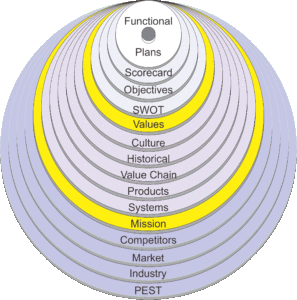
There is a model developed by mathematician Eduard Lucas with many names but often called the Tower of Hanoi. The model comprises three pegs and several discs of varying sizes, stacked in order of size, with the smallest on top. The objective is to move the discs to a different peg. The rules are that only one disk may be moved from the top of a stack at a time, and that no disk may be placed on one smaller than the one being placed.
When the game was invented, it was accompanied by a legend about monks in a monastery having to move 64 golden disks. It was said that the world would come to an end once they were finished. If they move a disk every second, it would take approximately 585 billion years
Calculated as: Time = ((2number of disks – 1) x time per move).
Strategic planning is neither a singular act nor a linear process; at its most basic, it is a series of analytical considerations that move from the broadest environmental forces to the most fundamental operational ones. The image for the reflection can be referred to as the tower of strategy or the onion model of strategic planning, depending on the perspective. There are many exercises that can be followed during strategic planning, but for illustrative purposes, the tower depicts a concentric, layered model of only 15 disks moving outward from a central core of functional plans. The diagram encodes a logic that is both hierarchical and systemic; each layer conditions the layer within it, but none can be read in isolation.
There are two key differences between the Tower of Hanoi and the strategic tower. The first is that there should be no time limitations on moving the disks. In strategic planning, the disk should be considered moved only when the participants have reached consensus and a mutual understanding of both the exercise and the realities identified in that disk. Secondly, although depicted and functioning as individual disks, there are groupings of disks that require consolidation before moving to the next grouping.
Simply stated, the organisational mission cannot be defined unless the environment has been carefully scanned and understood. Team members will only understand the needs, wants and gaps in the market when that is done. Next, the company vision can only be determined once the environment and organisational realities have been reviewed.
The Outer Environment
The outermost ring of the framework is the PEST/PESTEL analysis — Politico/legal, Economic, Socio/cultural, and Technological factors. This layer is not one that organisations control; it is the ocean in which they swim. Failure to monitor the macro environment has historically led to catastrophic strategic misalignment. At present, firms that ignore the technological disruption embedded in Industrial Revolutions 4, 5 and the start of IR6 will find themselves seriously disadvantaged, no matter how polished their internal planning had been. The placement of PEST at the base of the diagram is therefore not incidental; it indicates the playing field.
The second ring draws on 1 foundational Five Forces framework, which argues that industry conditions determine the profitability ceiling available to any firm in that space. The firm that understands its industry can position itself intelligently; the firm that does not is simply guessing. The Market layer further sharpens the focus, directing attention to the specific segments, customer needs, and demand dynamics that are immediately relevant to the organisation’s competitive scope 2. The Competitors ring brings into view the specific actors — their capabilities, strategies, and vulnerabilities — whose behaviour will most directly shape the viability of any strategic move. Together, these four external rings indicate the playing field, the competition, the conditions and the spectators. It is through understanding the environment that gaps are identified, and a large part of why customers will walk past a competitor to get to a specific company is explained. The balance of the reason is found in organisational understanding.
Tangible Organisational Context
The organisation mission provides the anchor of the strategy. It defines why the organisation exists. 3, in their study of visionary companies, found that organisations with clearly articulated and authentically held missions consistently outperformed those for whom mission was merely performative. A mission that is valid, realistic, and genuine shapes every strategic decision that follows; one that is placed on the wall without commitment merely decorates.
After defining the mission, strategic discussions and analysis require a dual perspective. Both of these perspectives require an in-depth, on-the-floor understanding of how the company functions. It cannot be done based on organograms and management reports or by remembering how it was. The first perspective is an honest review of the organisation, its systems, products and value chain. The second perspective is the organisation and its functions’ applicability in working toward addressing the organisational mission defined above.
The Invisible Components: Culture and Values
The Culture and Values layers occupy the transitional zone between the organisation’s structural dimensions, its strategic intent, its internal functioning, and the ultimate SWOT analysis. These two are the intangible drivers of organisational functioning. 4 defined organisational culture as the pattern of basic assumptions that a group has invented, discovered, or developed in learning to cope with its problems of external adaptation and internal integration. Many authors have argued that when a strategy violates the organisation’s cultural assumptions, the strategy will be “ignored” in favour of the culture. This is often seen when technically sound strategies misfire in practice: the plan is coherent, the systems and structures are in place, but the soil in which it must grow is hostile to it. Ideally, culture must be assessed – there are ways to do it – and not just assumed from the rules or assumptions of “the way things are done.” Culture is much more pervasive and subtle.
Values are a second, pervasive, and subtle component. Like a mission, values are not something thought out at a planning session and pasted on a wall. They are the guides for, and indicators of, employees’ behaviour and ethics. It requires intensive review, workshops, and interactions at all levels of the organisation to identify and instil company values. The relationship between values and culture is one of mutual constitution: values, when lived rather than laminated on a wall, generate cultural norms, which in turn reinforce and transmit those values across generations of organisational membership.
It is when the internal functioning, culture and values are known that one can answer the second part of the question, why people walk past competitors. 5 went further, proposing that culture itself can be a source of sustained competitive advantage when it is valuable, rare, and imperfectly imitable. One can argue that the inner dimensions of the onion model are not soft considerations to be accommodated, but strategic assets to be deliberately cultivated.
Strategic Intent: SWOT, Objectives, and the Balanced Scorecard
Once the external and internal realities are understood and consensus exists, the strategic planning session moves from a search for information to decision-making. The SWOT layer brings external and internal analysis into direct confrontation with one another. It fits in after environmental scanning has been completed and organisational self-knowledge assembled, but before strategic direction is committed to. The SWOT analysis requires critically facing the realities, identifying where internal strengths can exploit external opportunities, where weaknesses expose the organisation to threats, and where strategic investment is most likely to yield durable advantage. Once the SWOT analysis is complete, the next step is to compile objectives, review them for balance, and use them to develop functional plans. 6 demonstrated that objectives anchored in a Balanced Scorecard – spanning financial, customer, internal process, and learning perspectives – provide the integrative logic that links strategic intent to operational accountability.
Conclusion
Strategies often fail, not because they are analytically deficient but because there is no clear collective understanding of the environment. This is one aspect found in entrepreneurial firms where most or all employees know what the company is facing – or are involved in scanning the environment. A second reason for failure is that the connection between strategic intent and functional behaviour is never made explicit. Functional managers must understand the thinking behind the objectives and their origins. Strategic management requires not merely the formulation of intelligent strategy but its integration across all organisational functions – a feat only achievable when each function understands its role and realities within the broader strategic logic encoded in the outer rings.
The concentric model is not merely a checklist of strategic exercises; it is a reminder of aspects that must be investigated, researched, discussed and that remain open until there is a common understanding among all participants. It is a theory of strategic cognition: a claim about what must be understood before what can be decided, and what must be decided before what can be executed. The highlighted rings of Mission and Values are the model’s most provocative editorial choice, asserting that while environmental intelligence shapes the strategic space available, it is purpose and principle that determine which of those spaces an organisation is willing to inhabit.
In an era of rapid change, the temptation to collapse strategic planning into a repetitive cycle of operational adjustment is understandable. Strategy insists on depth before speed, comprehension before commitment. The layers cannot become bureaucratic ritual; they are the cognitive discipline without which strategy is merely improvisation with a mission statement attached.
Endnotes
- Michael E. Porter, Competitive Strategy: Techniques for Analyzing Industries and Competitors (New York: Free Press, 1980).
- Philip Kotler and Kevin Lane Keller, Marketing Management, 15th ed. (Upper Saddle River, NJ: Pearson, 2016).
- James C. Collins and Jerry I. Porras, Built to Last: Successful Habits of Visionary Companies (New York: HarperBusiness, 1994).
- Edgar H. Schein, Organizational Culture and Leadership (San Francisco: Jossey-Bass, 1985).
- Jay B. Barney, “Organizational Culture: Can It Be a Source of Sustained Competitive Advantage?” Academy of Management Review 11, no. 3 (1986): 656–665.
- Robert S. Kaplan and David P. Norton, “The Balanced Scorecard: Measures That Drive Performance,” Harvard Business Review 70, no. 1 (1992): 71–79.

Leave a Reply