
Strategic planning is too often reduced to an exercise: apply a framework, fill in a template, produce a document.
There are many books and articles on strategy, strategic management, tools, and techniques to use and many more books on strategic models and strategic mindsets are published annually.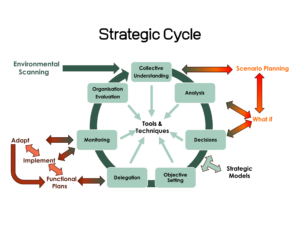 Unfortunately, this wealth of information and the sheer volume to consider have an unexpected outcome: strategic planning often becomes an exercise-driven process. A process of applying two or three tools and compiling anything between a one-pager and a book. There are many one-page strategy templates available online.
Strategic management is too important to be simplified and become an exercise-driven process. But which of the multiple tools, multiple strategic models, internal aspects such as culture, or environmental factors that affect organisational functioning should one focus on? This is where Leonard Cohen’s 1992 song “Anthem”¹² captures a parallel insight: that tallying the individual parts of a system never yields its whole. Focusing exclusively on exercises and techniques will not, in itself, produce strategic understanding.
At their core, the methodologies, exercises, and models depend on people’s thinking. Thinking during strategic planning is clearly different to the normal day-to-day bottom-up thinking. To use a cliché, strategic planning and strategic management require a big picture. It does, however, require continued environmental scanning, self-monitoring, and critical thinking.
While not negating the value they bring, if one thinks of the exercises and tools from a systems-thinking perspective, they become fundamental-level triggers: “Did you think of this?” Did you consider the macro environment? Did you consider the industry? And, and. With this approach, the tools and techniques serve as stepping stones to building a broader understanding. It becomes clear that systems-thinking is the primary component of strategic management. The specific strategic system is understood through the tools and techniques that point to its different parts.
The Strategic Cycle: An Integrative Framework for Organisational Strategy
Books often refer to a strategic cycle, noting the time frames between conceptualising and implementation. There is, however, a perspective that every discussion is a strategic discussion, which seems to be counter to the strategic cycle concept. The diagram of a strategic cycle presented here reflects a dynamic, systemic understanding of strategy as an ongoing, recursive process of learning, deciding, acting, and revising.
The framework comprises eight interconnected stages — Collective Understanding, Analysis, Decisions, Objective Setting, Delegation, Monitoring, and Organisation Evaluation — all centred on a core hub of Tools and Techniques. External inputs, including Environmental Scanning, Scenario Planning, “What If” analysis, and Strategic Models, feed into and flow out of the cycle, while implementation mechanisms such as Functional Plans, Delegation, and Adaptation close the loop between intention and execution.
The Core Cycle: From Understanding to Evaluation
Although the cycle seems to begin with Collective Understanding, it requires a prior stage with no time frame or set limitations. This stage requires all people involved in strategic management to live with questions: constant environmental scanning and evaluation of developments. Here, each person will form ideas and perceptions of environmental realities.
This is not merely a passive state of awareness but an active, socially constructed process. Senge argued in The Fifth Discipline that organisations become effective learners only when members develop shared mental models¹ — a view echoed in Weick’s concept of organisational sensemaking, wherein actors collectively interpret ambiguous environments to produce coordinated action². Without collective understanding, strategic analysis risks being pursued in isolation, producing technically sound but organisationally inert outputs.
This stage resonates strongly with the concept of the learning organisation¹ and with the broader literature on organisational adaptation. Collins and Porras argued in Built to Last that enduring organisations are distinguished not by any single strategy but by an institutional capacity for self-renewal³ — a quality that Organisation Evaluation is explicitly designed to cultivate.
Although discussions about environmental understanding should constantly take place, the official collective understanding begins with strategic planning. In this stage, members freely share their perceptions, ideas and understanding of what is happening in the world, their industry and the organisation. The objective is to develop a collective view and understanding. This requires the absence of criticism – although questions must be asked for clarification – and judgement. The idea is to build a collective rich picture of all aspects related to the organisation’s functioning, a shared cognitive framework among strategic decision-makers. The idea is to develop a picture shared by all in the same way as a painting. Not just the image, but also the details, the colours, and even the brush strokes.
Analysis
Only once a collective understanding has developed can the team start with analysis.
At this stage, as a critic evaluates the painting, the team begins applying tools and techniques to conduct a structured examination of internal capabilities and external conditions. Porter’s Five Forces framework⁴ and later theories such as dynamic capabilities theory are applied to ensure everything was considered and indemnify what still remains still unknown⁵
The unknowns are set aside, evaluated, and addressed – usually after the planning sessions – with scenario planning. These are plans developed “in case” and considered from the perspective of “What if”. Although not shown, these again feed back into environmental scanning.
Understanding and analysis are the basis of strategy. It converts raw environmental and internal data into actionable intelligence, making the linkage to collective understanding critical. If analysis is conducted without a shared interpretive context, even sound findings may be contested or ignored.
Planning
Analysis is followed by decision-making – identifying what is going to be addressed, usually involving a SWOT analysis. This analysis helps the team understand what must be done, where, and why. This is the stage where strategic options are evaluated, and commitments made.
The Balanced Scorecard, introduced by Kaplan and Norton, is one of the most widely adopted frameworks for evaluating objectives for implementation, extending performance measurement beyond financial indicators to encompass customer, internal process, and learning and growth dimensions⁶. The presence of Monitoring in the cycle underscores that strategy is not self-executing — it requires continuous feedback to remain calibrated.
Decision-making under conditions of uncertainty is one of the most studied phenomena in management science. Simon’s concept of bounded rationality remains central here⁷ — managers do not optimise but satisfice, constrained by cognitive limits and incomplete information. This is where the importance of environmental scanning and collective understanding becomes reality. The behavioural economics literature, particularly the work of Kahneman and Tversky, further complicates the picture by demonstrating systematic cognitive biases that distort strategic choice⁸. This underscores the importance of structured decision-making processes and deliberative tools that counteract these tendencies.
Turning decisions into actions involves Objective Setting. Objectives serve as the connective tissue between high-level strategic decisions and the operational activities that follow. The classical management-by-objectives (MBO) framework proposed by Drucker⁹ along with more recent frameworks such as OKRs (Objectives and Key Results) or writing SMART objectives have become key.
The balance of the model reflects operations management at a strategic level. Objectives are delegated to functional departments and appropriate organisational levels. This stage also requires understanding the principles of organisational design, where the adage of structure follows strategy becomes real. The implementation must be monitored, which completes the loop by tracking performance against objectives.
Organisation Evaluation, is the internal environmental scanning feeding back into the broader strategic cycle, reflecting whether the organisation’s structure, capabilities, and culture remain aligned with its strategic intent. A core part of organisation evaluation is cultural understanding, an aspect often overlooked or glossed over.
Conclusion
The Strategic Cycle depicted in the image is, at its core, a model of organised intelligence: an attempt to systematise the complex, often messy process by which organisations make sense of their environments, commit to directions, mobilise resources, and learn from experience. It draws implicitly on decades of management theory — from Simon’s bounded rationality to Senge’s learning organisation, from Porter’s competitive analysis to Mintzberg’s emergent strategy¹¹ — and synthesises these into an iterative framework that honours both the analytical rigour and the adaptive flexibility that effective strategy demands. The cycle’s greatest strength is also its most demanding requirement: it asks organisations to engage in continuous, disciplined reflection rather than periodic, reactive planning. In environments characterised by volatility, uncertainty, complexity, and ambiguity,¹⁰ this capacity for strategic iteration is not a luxury — it is an imperative.
References
1 Senge, P. M. (1990). The fifth discipline: The art and practice of the learning organization. Doubleday.
2 Weick, K. E. (1995). Sensemaking in organizations. Sage Publications.
3 Collins, J. C., & Porras, J. I. (1994). Built to last: Successful habits of visionary companies. HarperBusiness.
4 Porter, M. E. (1980). Competitive strategy: Techniques for analyzing industries and competitors. Free Press.
5 Teece, D. J., Pisano, G., & Shuen, A. (1997). Dynamic capabilities and strategic management. Strategic Management Journal, 18(7), 509–533.
6 Kaplan, R. S., & Norton, D. P. (1992). The balanced scorecard — measures that drive performance. Harvard Business Review, 70(1), 71–79.
7 Simon, H. A. (1955). A behavioral model of rational choice. Quarterly Journal of Economics, 69(1), 99–118.
8 Kahneman, D., & Tversky, A. (1979). Prospect theory: An analysis of decision under risk. Econometrica, 47(2), 263–291.
9 Drucker, P. F. (1954). The practice of management. Harper & Row.
10 Bennis, W., & Nanus, B. (1985). Leaders: The strategies for taking charge. Harper & Row.
11 Mintzberg, H., & Waters, J. A. (1985). Of strategies, deliberate and emergent. Strategic Management Journal, 6(3), 257–272.
12 Cohen, L. (1992). Anthem [Song]. On The Future [Album]. Columbia Records.

Leave a Reply